Whether you are launching your first campaign or refining an existing one, understanding how meta ad campaigns work across Facebook, Instagram, and beyond is the difference between wasted spend and measurable growth. This article breaks down every layer of the Meta advertising ecosystem so you can create ads that actually perform.
What Are Meta Ads (Quick Answer)
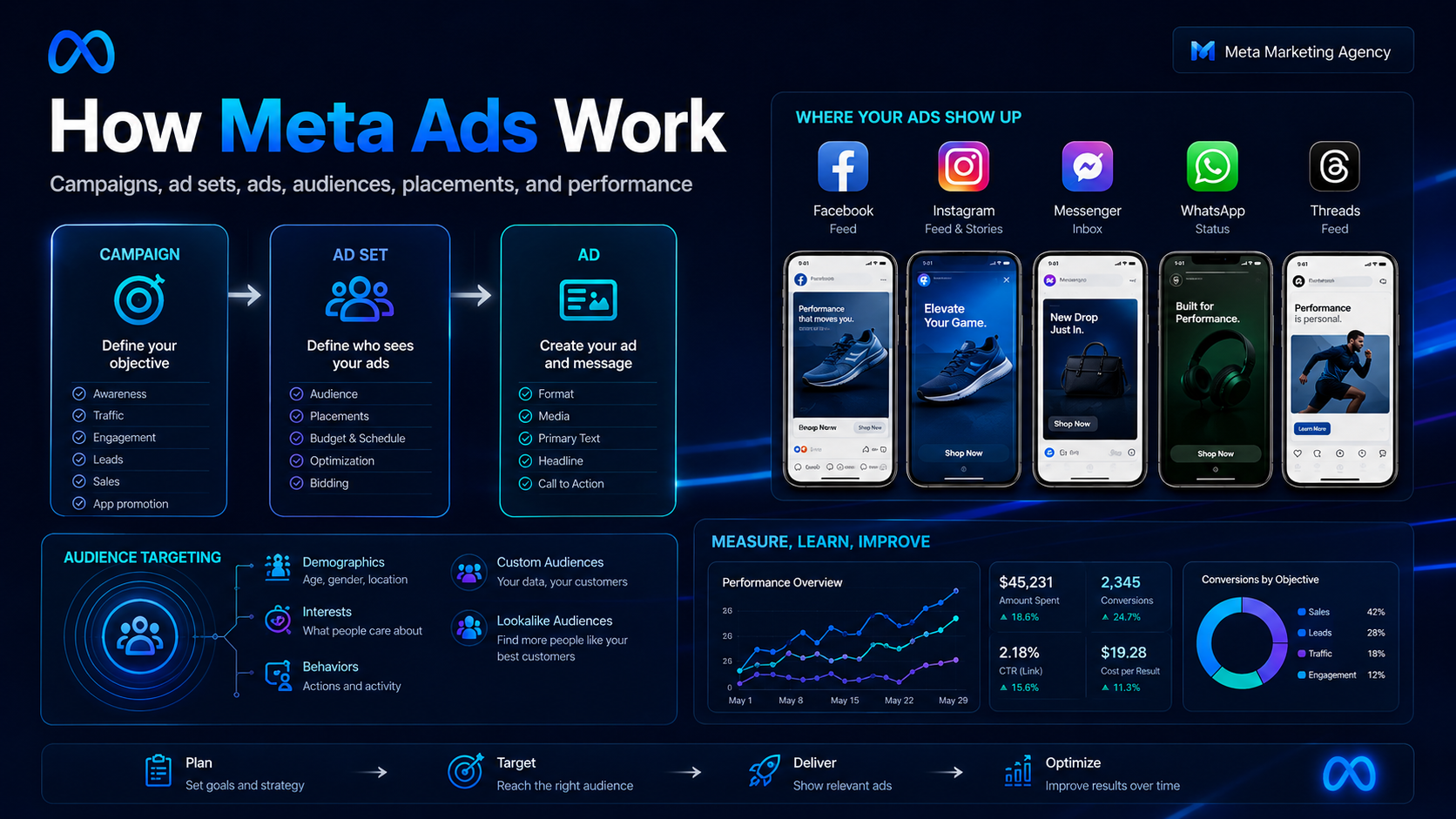
Meta ads are paid placements delivered across meta platforms-Facebook, Instagram, Messenger, WhatsApp, Threads-including instagram ads as part of this cross-platform inventory, using meta technologies and an auction-based delivery system. AI analyzes user data to optimize ad delivery automatically, improving the platform’s ability to simplify campaign management and make it one of the most efficient advertising solutions available today.
Where meta ads can appear:
- Facebook feed and in-stream video
- Instagram feed, instagram stories, and Reels
- Messenger inbox and sponsored messages
- Meta audience network (third-party apps)
- WhatsApp (expanding placements)
Businesses use meta ads manager (inside meta business suite and the accounts center ecosystem) to create, manage, and optimize campaigns at every level. Meta Ads Manager allows real-time tracking of campaign performance, giving advertisers granular control over spend and results.
Meta ads matter for performance marketing because they can reach over 3 billion active users globally while offering cost-effective options with measurable performance tracking. They support the entire customer journey from awareness to conversion, making them essential for companies serious about growth. Meta ads provide massive reach across multiple platforms, and that reach is paired with targeting precision no other network matches at scale. Working with a dedicated Meta Ads Agency gives you access to the strategic depth needed to capitalize on that scale, especially when you need a full-funnel, CRO-focused Meta ads agency to turn spend into profit.
How Meta Ads Work
Meta Ads Manager has three levels: campaign, ad set, and ad. This structure separates strategic decisions (objective, budget) from tactical ones (audience, creative).
Meta ads operate on a real-time auction model to determine ad visibility. Each time an impression is available, three factors decide the winner:
- Bid- what you are willing to pay for the desired action
- Estimated action rate- how likely the user is to take that action
- Ad quality and relevance- feedback signals and content quality
The step-by-step process: choose an objective (Sales, Leads, Traffic), define your target audience, set your ad budget (you can choose between daily or lifetime budgets in Ads Manager), select placements like facebook feed or instagram stories, upload creative (image ads, video ads, carousel ads), and publish.
Use Advantage+ for automated budget allocation across ad sets-this is now default best practice for most advertisers. The learning phase requires roughly 50 optimization events per ad set per week. Big budget changes, major audience edits, or creative overhauls can reset it, leading to unstable campaign results.
Key metrics to monitor in ads manager:
- CPM (cost per thousand impressions)
- CTR (click-through rate)
- CPC (cost per click)
- CPA (cost per acquisition)
- ROAS (return on ad spend)
- Conversion rate
Monitor key metrics like conversion rates and cost per click to make informed decisions during and after the learning phase.
Meta Ads Manager Structure: Campaign, Ad Set, and Ad Levels
Ads manager-accessible via meta business suite and accounts center-is the core tool for building and analyzing meta ad campaigns. Meta Ads Manager supports various ad formats like carousel and video within this unified interface.
- Campaign level: Choose your objective and buying type (auction vs. reach/frequency). Special campaign types like Advantage+ Shopping campaigns automate targeting and delivery for ecommerce. Campaign budget optimization distributes spend across ad sets.
- Ad set level: Define your target audience by location, age, gender, interests, behaviors, or use custom and lookalike audiences. Select placements (facebook feed, Instagram feed, Reels, Stories, messenger, meta audience network). Set budget, schedule, and optimization event (e.g., Purchase, Lead). Lead ads help collect sign-ups or customer information directly at this level.
- Ad level: Select ad format-single image, video, carousel, collection, or Instant Experience. Add primary text, headline, description, CTA button. Assign your facebook page and instagram account.
Practical example: one campaign ("Sales – Summer Launch") with three ad sets targeting broad lookalikes, interest-based segments, and retargeting. Each ad set contains three ads testing different creative angles (UGC video, product demo, static lifestyle). This structure lets you isolate what drives results.
Main Meta Ad Formats and Creative Best Practices
Creative and ad format selection are the primary performance drivers in the meta ads ecosystem. Meta advertising prioritizes user-generated content to enhance engagement, so authenticity matters more than polish, particularly when paired with tailored, story-driven Meta campaigns that build brand loyalty.
Meta ads include flexible, single image, video, carousel, and collection formats:
- Single image ads- one static visual with text. Use high-contrast visuals, minimal on-image text, and mobile-first cropping.
- Video ads- video ads are effective for capturing user attention on meta platforms. Use 9:16 for Stories/Reels, 1:1 for feeds. Hook viewers in the first two seconds. Add captions since most users watch without sound.
- Carousel ads- carousel ads allow users to scroll through multiple images or videos, ideal for showcasing product features or telling a sequential story.
- Collection ads- collection ads showcase a group of products in a single ad with an Instant Experience storefront.
- Dynamic/catalog ads- automatically show relevant products based on user interactions and browsing behavior.
For evolving placements, Reels ads are gaining significant traction. Ensure creative is adaptable across formats-vertical for immersive placements, square for feeds.
Creative testing methodology:
- A/B test hooks, formats, and offers separately
- Avoid making too many changes at once (resets learning)
- Use Ads Manager experiments for controlled split tests
- Test lifestyle imagery vs. product-only for image ads
Meta Platforms and Key Ad Placements
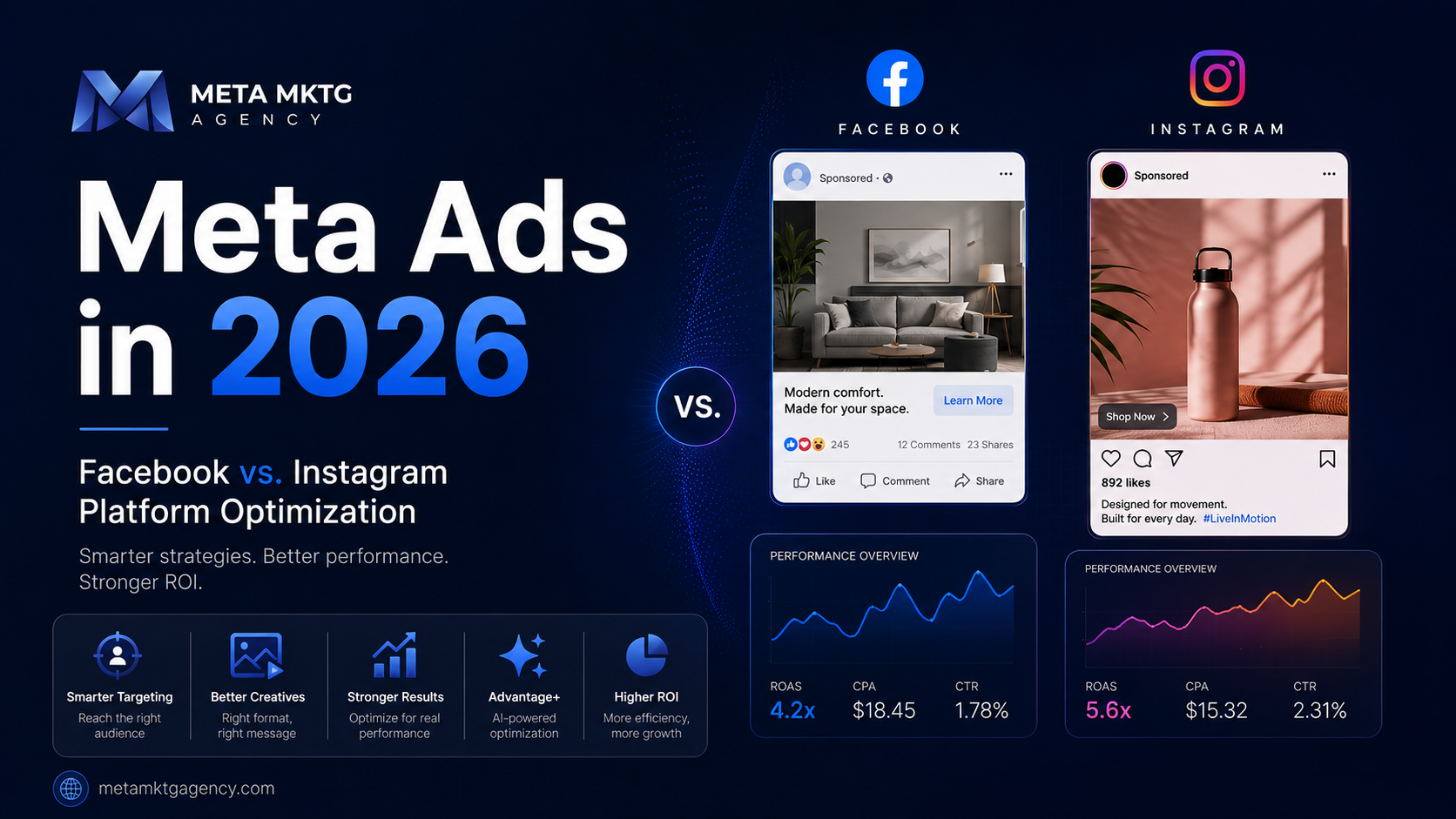
Meta platforms-Facebook, Instagram, Messenger, meta audience network, WhatsApp-each provide different contexts while using the same ads manager infrastructure. Meta ads can target over 3 billion active users globally across these surfaces.
Start with automatic placements unless you have clear data showing one placement underperforms. Automatic placements let the system allocate budget where it performs best.
- Facebook feed- the highest-volume placement for most advertisers; supports all ad formats
- Instagram feed- strong for visual brand storytelling and ecommerce
- Instagram stories and Reels- full-screen, immersive; ideal for short video and branded content
- Messenger- sponsored messages and inbox ads for direct engagement
- Meta audience network- extends reach into third-party apps
Ad formats adapt to placement: vertical 9:16 for stories and Reels, square 1:1 for feeds. The target audience's behavior differs-passive scroll in feeds vs. full-screen immersion in Stories-so creative style should match. Review placement-level performance in Ads Manager breakdowns, but avoid over-fragmenting placements early in a campaign.
Targeting Options and Audience Strategy in Meta Ads
Effective target audience strategy combines meta's native data with first-party data and algorithmic optimization. Modern meta ads utilize AI for audience targeting, and meta ads leverage extensive user data to target specific audiences with precision.
Core targeting types:
- Core audiences- businesses can target audiences based on demographics, interests, and behaviors. Meta ads allow precise audience targeting based on demographics like age, gender, and location.
- Custom audiences- meta ads allow businesses to create custom audiences from website behavior (via pixel or Conversions API), app users, video viewers, engaged users, and customer lists.
- Lookalike audiences- find new people who resemble your best customers
Prospecting guidance:
- Broad targeting (18+, location only) paired with strong creative and algorithmic delivery works well for larger budgets when reaching the right audience
- Layered interest targeting suits niche offers or limited budgets when reaching specific audiences
Retargeting guidance - effective retargeting capabilities are available for warm audiences:
- Website visitors (last 7–30 days)
- Add-to-cart but no purchase
- Engaged users from your facebook page or instagram posts
- Video-view audiences (25–75% view thresholds)
Accounts center connects user identity across meta platforms, improving cross-device attribution and audience building. For signal resilience, implement server-side Conversions API alongside Meta Pixel. Meta Pixel helps track and optimize post-click actions, and combining it with CAPI ensures robust data collection in a post-iOS 14.5 world.
Meta Business Suite, Ads Manager, and Accounts Center: Tools Overview
Understanding these three tools prevents confusion and helps you gain access to the right features:
- Meta business suite- central hub for managing pages, Instagram profiles, organic posts, inbox messages, and high-level insights. Use it for day-to-day social presence, boosting posts, and maintaining your brand's presence across platforms.
- Meta ads manager- the advanced interface for serious advertising. Build campaigns, run detailed breakdowns, set up A/B tests, create custom columns, and manage rules. This is where you run ads at scale or implement full-funnel, data-driven Meta advertising systems.
- Accounts center- where users connect Facebook, Instagram, and other meta accounts to manage logins, identity, and privacy/ad settings. Proper linking here directly affects how audiences and reporting work for advertisers.
Use Business Suite for quick boosts and social management. Use Ads Manager for performance-focused meta ad campaigns. Use Accounts Center to ensure all accounts and assets are properly linked. Meta ads integrate with third-party CRMs for workflow automation, extending the value of these tools into your broader sales process.
Setting Up Your First Meta Ad Campaign (Step-by-Step)
Here is a practical, chronological process for launching your first campaign:
- Prepare assets- set up your facebook page, Instagram Business account, Business Manager/meta business suite access, payment method, and install Meta Pixel/Conversions API on your website.
- Define objective and KPIs- before opening Ads Manager, clarify your goal: lead cost target, ROAS goal, or number of sales per week. Log your benchmarks.
- Build campaign- select your objective in Ads Manager. Choose Advantage+ campaign options where appropriate. Set a daily or lifetime ad budget that can support at least 50 optimization events per week.
- Configure ad sets- choose locations and age ranges. Define your target audience (broad vs. interest stacking vs. lookalikes). Set placements to Advantage+ placements. Choose your optimization event (Purchase, Lead, Add to Cart).
- Create ads- select your facebook page and instagram account. Choose your format (image ads, video ads, carousel ads). Upload creative, write primary text, headline, and description. Select a CTA button. This is where ad creation quality determines your results.
- Review and publish- double-check URLs, UTM parameters, and tracking settings. Use test tools to ensure pixel events fire correctly before increasing spend. You can adjust your Meta ads budget in real time as data comes in.
Optimization, Scaling, and ROI with Meta Ads
Long-term success with meta ad campaigns depends on continuous optimization, not one-time setup.
After 3–7 days, review performance in Ads Manager. Distinguish between learning, learning limited, and active delivery statuses. Make data-driven decisions only after sufficient data accumulates.
Optimization levers:
- Rotate and refresh creative before fatigue sets in
- Gradually increase ad budgets by 15-20% for better performance-avoid sudden jumps that reset learning
- Refine audiences based on comments, user interactions, and conversion data
- Pause underperforming ad sets to reallocate budget to winners
Scaling strategies:
- Vertical- increase budget on profitable ad sets gradually
- Horizontal- duplicate ad sets to new geos or audiences
- Advantage+- meta ads offer automated optimization tools like Advantage+ Shopping campaigns for larger ecommerce budgets
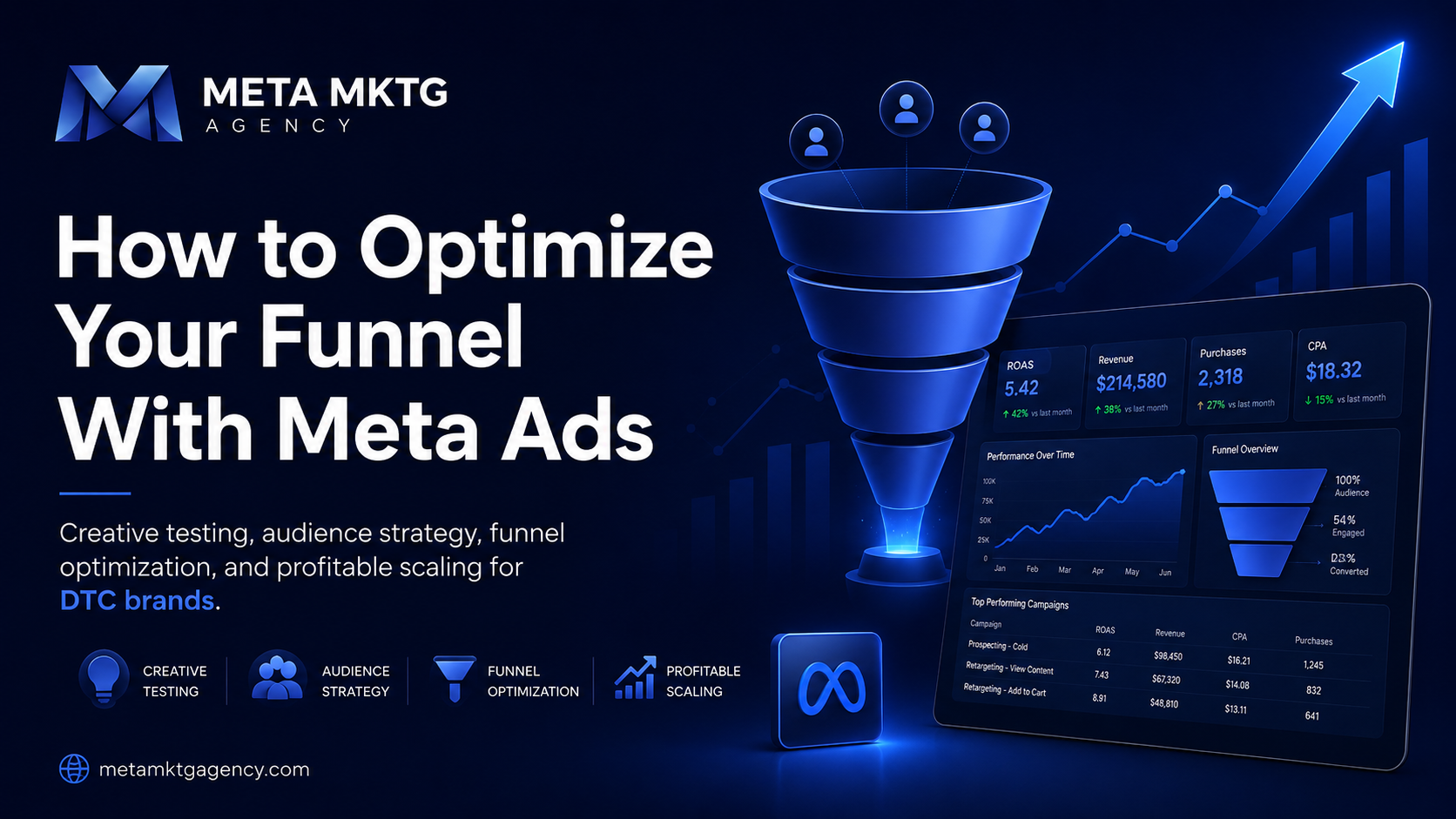
Well-structured full-funnel Meta advertising strategies ensure your scaling efforts align with each stage of the customer journey.
Attribution windows (7-day click, 1-day view) affect reported performance. Changing them changes your numbers, so pick a consistent window and stick with it. A specialized Meta Ads Agency can help with advanced testing matrices, creative frameworks, and full-funnel attribution to achieve stronger ROI.
Compliance, Policies, and Data Protection in Meta Ads
Adherence to Meta's advertising policies and regional regulations (GDPR, CCPA) is essential for account stability. Advertisers who ignore compliance risk ad rejections, restricted accounts, and wasted spend on social issues and sensitive categories.
Key policy areas:
- Prohibited content- weapons, adult content, misleading claims
- Restricted industries- finance, health, politics require additional approval or disclaimers
- Creative standards- no deceptive clickbait text, no non-compliant before/after images
- Landing pages- must include clear offer, privacy policy, no malicious redirects
Data in the meta ads ecosystem is encrypted in transit and aggregated. Configure data-sharing settings responsibly in meta business suite and accounts center. Set up and test Conversions API alongside Pixel, auditing periodically to ensure events are deduplicated.
If your ad gets rejected, check the account quality score in Business Suite. Most disapprovals can be appealed through the ad review process with corrected creative or copy.
SEO, Meta Titles, Meta Descriptions, and Internal Linking
While "meta ads" refers to advertising on meta platforms, on-site SEO is crucial for ranking content about Meta advertising.
- Meta title:"Meta Ads: Complete Guide to Meta Ad Campaigns, Formats & Strategy" - includes core keyword naturally
- Meta description:"Learn how to create, manage, and optimize meta ad campaigns across Facebook and Instagram. Covers Ads Manager, ad formats, targeting, and scaling strategies." (~155 characters)
- Link internally from this article to the main "Meta Ads Agency" services page using that exact anchor text near the top and bottom
- Link to supporting internal resources (video ads guide, Conversions API setup) using descriptive anchor text
- Promote your brand's presence by ensuring every piece of educational content reinforces the canonical keyword structure
Key Takeaways and Next Steps
Meta ads deliver unmatched scale and precision when campaigns are built on solid structure, strong creative, and ongoing optimization. From choosing the right objective in Ads Manager to testing ad formats across placements, every decision compounds into better campaign results over time, especially when supported by an Intelligent Ads Protocol-driven Meta agency.
Action items:
- Define clear objectives and KPIs before touching Ads Manager
- Set up tracking with both Meta Pixel and Conversions API
- Start with a simple campaign structure and let the learning phase complete
- Prioritize creative testing over audience micro-segmentation
- Monitor performance regularly and scale winners gradually
Ready to achieve stronger results from your meta ad campaigns? Partner with a dedicated Meta Ads Agency for expert strategy, setup, and scaling that turns ad spend into measurable growth.